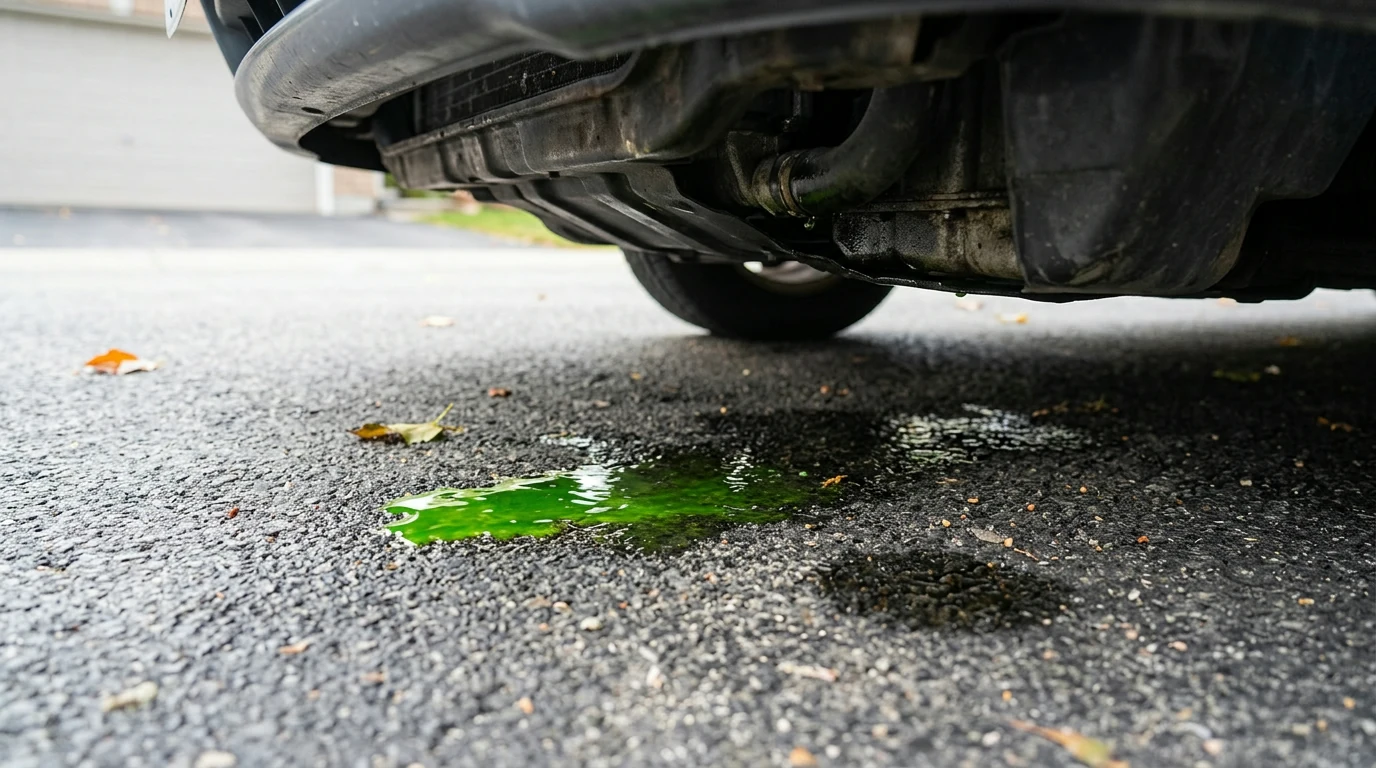
Leaking antifreeze, also called engine coolant, can be bright green, orange, pink, red, yellow, blue, or purple. Its color depends on the coolant formula in your vehicle, so there is no single color that identifies every antifreeze leak. Once coolant collects dirt or ages, it may look brownish instead.
If you find a colored puddle under your car, note where it appears and check the coolant reservoir level when the engine is completely cool. A drop in the level makes a coolant leak more likely. Color alone is not enough to confirm it: windshield washer fluid and other vehicle fluids can also be brightly colored. Our guide to car fluid leak colors can help you compare what you’re seeing.
Coolant often feels slightly slippery and may have a sweet smell. You might find it near the front of the vehicle, beneath the radiator area, or closer to the engine, depending on where the leak begins. Look for damp hose connections, drips, or dried, crusty residue around cooling-system components.
A small amount of clear water under the passenger side after you’ve used the air conditioner is usually condensation, not antifreeze. If the fluid is colored, the reservoir is low, or the temperature gauge is rising, treat it as a possible coolant leak rather than assuming it is harmless water.
Keep children and pets away from the puddle. Antifreeze is poisonous if swallowed, and a spill should be cleaned up promptly using an absorbent material and disposed of according to local rules.
Do not remove the radiator cap while the engine is hot; pressurized coolant can cause serious burns. If the engine is overheating, you see steam, or coolant is pouring out, pull over safely, turn off the engine, and arrange a tow. For a slower leak, have the cooling system inspected and repaired before relying on the car for regular driving.
If you need to top off coolant after the engine has cooled, use a product that meets your vehicle manufacturer’s specification. Our team recommends choosing by the required coolant type, not by color: different formulas can share a color, and mixing incompatible coolants can reduce cooling-system protection.
A small leak can become a larger one without warning, and low coolant can cause the engine to overheat. Have the leak repaired promptly; if the temperature gauge rises or you see steam, stop driving and arrange a tow.




Leave a comment