
Pinterest can feel like an endless scroll of pretty looks—until you treat it like a personal styling system. When you save with intention, Pinterest becomes a visual “decision tool” that helps clarify what you like, spot repeat patterns, and shop with fewer mistakes. The goal isn’t to copy someone else’s wardrobe; it’s to turn your own taste into repeatable outfit formulas that work for real life: workdays, weekends, travel, events, and everything in between.
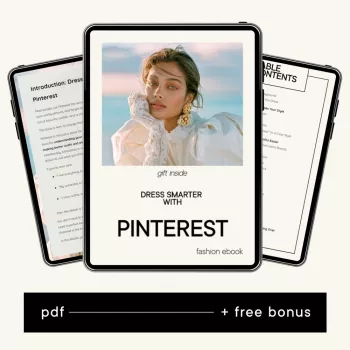
If you want a structured, step-by-step approach, the Dress Smarter With Pinterest ebook guide lays out an easy framework for saving, sorting, and translating pins into confident choices—without adding clutter to your closet or your brain.
Pinterest is uniquely helpful because it collects real-world outfit examples across seasons, budgets, and body types in one place. With a focused approach, patterns become obvious: repeated colors, silhouettes, fabrics, and styling “rules” that already match your taste—often before you can describe that taste in words.
Those saved pins become a visual filter for your closet and your shopping cart. When you consistently see the same jean shape, jacket length, or shoe profile across your boards, it’s easier to edit what you own and stop impulse buys that don’t fit the bigger picture. Better still, a structure reduces decision fatigue: fewer choices, better combinations, and faster mornings.
For platform basics and saving features, Pinterest’s own documentation is a helpful reference: Pinterest Help Center.
The ebook focuses on translating inspiration into outfits that match real routines—so your “style” isn’t theoretical. It walks through board strategies that keep your pins easy to retrieve (fewer boards, clearer categories), methods for identifying your personal outfit formulas, and shopping checkpoints that confirm fit, versatility, and cost-per-wear before you buy.
It’s useful if you’re building style confidence from scratch, and it’s just as useful if you already love fashion but want a tighter system—one that reduces “closet full of clothes, nothing to wear” moments.
For a broader wardrobe-planning approach that pairs well with Pinterest formulas, the Capsule Wardrobe Builder Kit can help you narrow down essentials and build a more mix-and-match closet.
Start small and mirror how you actually get dressed. Four to six boards is plenty for most people: Work, Casual, Going Out, Shoes & Bags, Outerwear, and Outfit Formulas. The point is fast retrieval—if you need to hunt for a pin, you won’t use it when you’re running late.
The fastest way to make Pinterest actionable is to extract the “formula” behind a pin: silhouette + proportions + key pieces. For example: straight-leg jeans + fitted knit + loafers + structured tote. A formula is not a rigid uniform—it’s a template you can remix with different colors, fabrics, and accessories.
| Scenario | Formula | Why it’s easy to repeat |
|---|---|---|
| Everyday casual | Straight jeans + tucked tee + oversized button-down + sneakers | Works with multiple colors; layers adapt to temperature |
| Polished work | Ankle trousers + knit top + blazer + low heel/loafer | Swap blazer colors; consistent silhouette looks intentional |
| Weekend elevated | Midi skirt + fitted tank + denim jacket + sandals | Comfortable base; jacket changes the vibe fast |
| Cold-weather staple | Slim/straight pants + chunky knit + long coat + boots | One outerwear piece anchors the whole outfit |
| Simple dressy | Solid dress + statement earrings + minimal heel + clutch | One-piece base reduces styling time; accessories do the work |
If your boards show you consistently reach for a certain denim vibe, choose a pair that fits the silhouette you keep pinning—like the Levi’s men’s blue slip-on jeans with worn-out effect—and then style them across multiple formulas.
If you share or save affiliate-style recommendations anywhere, make sure disclosures are clear and easy to notice; the FTC guidance is a solid reference: FTC: Advertising and Marketing on the Internet (Disclosures).
A small set—about 4–6 boards—works best when the categories match how you actually dress (Work, Casual, Going Out, etc.). Fewer boards makes it easier to find pins quickly and turn them into real outfits.
Use your pins to build a few outfit formulas, then shop only for items that support those formulas. A quick filter helps: it should work in at least two formulas, pair with at least three items you own, and be wearable within two weeks.
Prioritize full outfits because they show proportions and styling (shoes, bag, outerwear), which is what makes a look wearable. Pin individual items only when they clearly complete a formula or fill a specific wardrobe gap.





Leave a comment