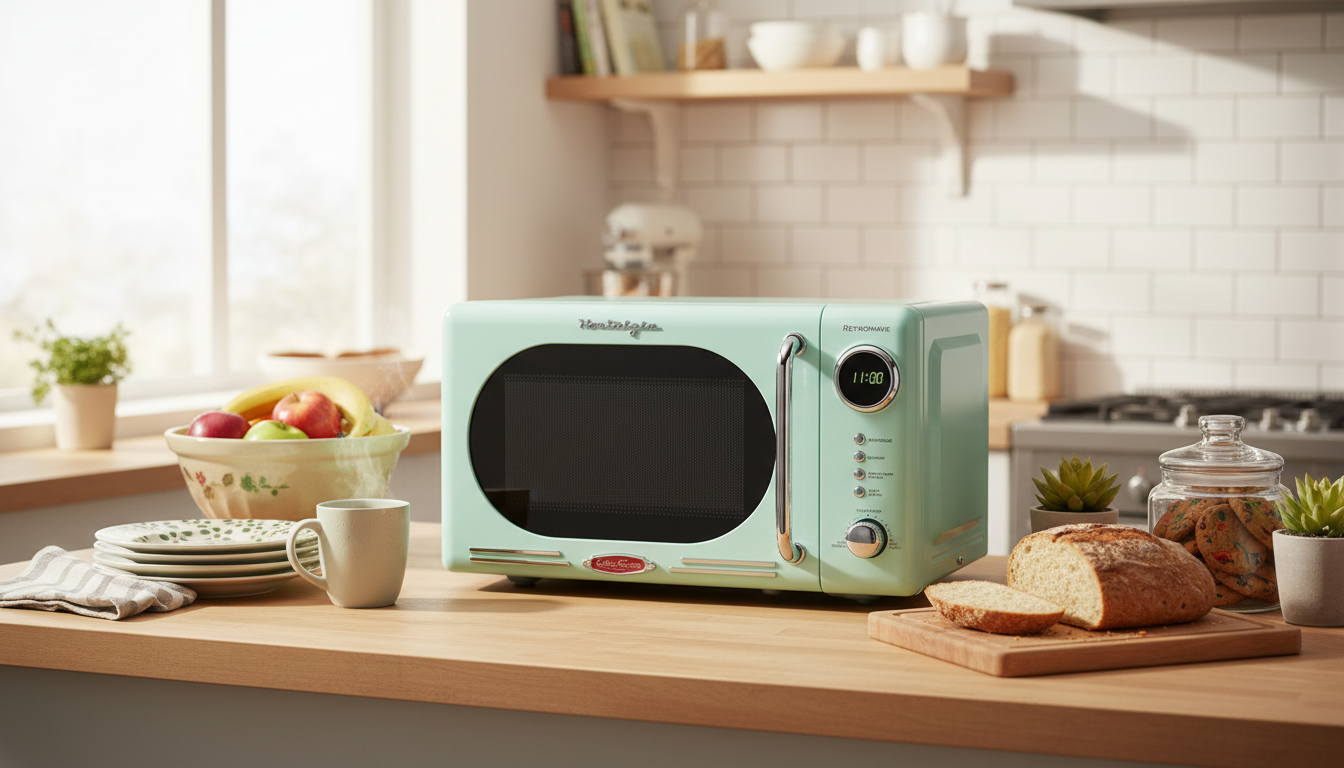
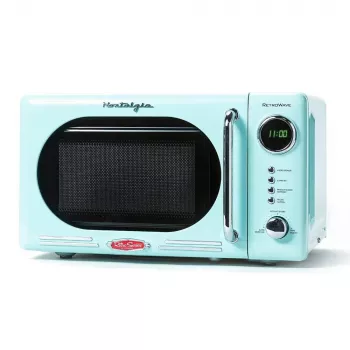
A compact countertop microwave can handle everyday reheating and quick cooking without taking over the kitchen. This retro-styled model pairs a classic look with a clear digital display, making it a practical fit for apartments, dorms, offices, and smaller kitchen setups. If you want a microwave that feels intentionally designed (not purely utilitarian) while still keeping operation simple, this 0.7 cu. ft., 700W option is built for the routines that happen most: warming coffee, reheating leftovers, and cooking quick single-serve meals.
This unit is designed around realistic daily needs rather than maximum capacity. A 0.7 cu. ft. interior fits common bowls, mugs, and smaller plates, while 700W power handles straightforward heating—just with slightly longer times than higher-wattage microwaves. The digital display adds clarity and control for quick adjustments, which can be especially helpful in shared spaces like offices or dorm kitchens.
| Feature | Specification | Practical takeaway |
|---|---|---|
| Capacity | 0.7 cu. ft. | Best for small plates/bowls and single-serve portions; limited space for oversized dishes. |
| Power | 700W | Reliable reheating with slightly longer cook times than 900–1100W units. |
| Controls | Digital display | Easier to read time/settings; better precision for short bursts. |
| Placement | Countertop | No installation required; needs a stable surface and ventilation clearance. |
If you’re shopping for a compact microwave with a standout look, see the Retro Countertop Microwave Oven with Digital Display – 0.7 Cu. Ft., 700W.
When the microwave sits out in the open—on a studio apartment counter, a dorm shelf, or a curated coffee station—appearance matters. Retro styling can complement vintage, mid-century, or colorful kitchen decor while still feeling modern to operate, thanks to the digital readout. Being able to see the countdown clearly from across the room is a small convenience that helps prevent accidental overcooking when you’re multitasking.
For a cohesive countertop setup, retro finishes tend to pair well with classic small appliances like toasters and kettles in similar tones. If the goal is an intentional, “put-together” kitchen corner, try coordinating with cabinet pulls, backsplash accents, towels, or storage canisters—small details that make the microwave look like part of the design instead of an afterthought.
A 700W microwave is made for daily heating and simple cooking, not the fastest cook times possible. In practice, that means you’ll often get the best results by using smart technique rather than just adding time and walking away.
For thicker foods—pasta, rice bowls, casseroles—medium power is your friend. Lower power helps heat travel inward more evenly, reducing the “hot rim, cold center” problem. Stirring halfway through and letting the food stand for a minute or two after the timer ends can make a surprising difference in texture.
Defrosting works best in short intervals with flipping or rotating. It’s normal for thin edges to warm faster than a frozen center, especially with compact microwaves. Short cycles help you stop right when the food loosens, instead of pushing past the point where corners begin to cook.
Butter, chocolate, and cheese can scorch quickly at full power. Lower power settings and short bursts help you sneak up on the right consistency. Even if you’re just softening butter for baking, a few short cycles are safer than one long run.
If you’re using a recipe written for a 1000W microwave, plan to increase the time modestly, then check earlier rather than running one long cycle. For food safety guidance when microwaving leftovers, the USDA’s overview is a useful reference: Microwave Ovens and Food Safety (USDA FSIS).
Compact microwaves shine when the space is tight, but measuring first prevents the most common frustrations. Check the countertop width and depth where the unit will sit, then confirm the door swing won’t collide with a wall, pantry side panel, or other appliances.
Ventilation also matters. Avoid pressing the microwave tight against a backsplash or sliding it into a closed cubby unless the manufacturer specifically allows it. A little breathing room supports airflow and helps the appliance run more comfortably over time.
Curious about general microwave efficiency and typical energy use? This primer is helpful for context: Microwave Ovens (Energy.gov).
For peace of mind about microwave safety standards, the FDA explains how microwave oven radiation is regulated and why properly maintained appliances are considered safe to use: Microwave Oven Radiation (FDA).
Yes—700W is sufficient for typical reheating and simple cooking, though it may take a little longer than higher-wattage microwaves. Using short intervals, stirring, and a brief standing time helps heat food more evenly.
It fits most standard bowls, mugs, and small plates comfortably. Larger casserole dishes or oversized dinner plates may not rotate well and can feel cramped.
Use lower power for thick foods, heat in short bursts, and stir or rotate midway through the cycle. Letting food stand for 1–2 minutes after heating also helps temperature even out.





Leave a comment